
She/Her/Hers
Lesbian
|
|
EMILY PRATT SLATIN | About | Press Kit | Notebook | Music Playlist | She/Her/Hers Lesbian |
Retired Career Fire and EMS Lieutenant-Specialist, Writer, and Master Photographer, living in Vermont.

April 7, 2026—Stamford, New York (Mom's House)
I didn't come back here looking for answers. That's the first thing that became clear—standing in the driveway, with the same quiet, the same arrangement of things mom left behind pretending nothing had changed.
Philosophy teaches you that most of what feels urgent isn't actually urgent—it's just poorly framed. The house used to feel like a question. Now it feels like something else entirely. Not an answer—something smaller, sharper, and far less negotiable.
This place used to define me in ways I didn't consent to. When my father was alive, identity felt like something I was supposed to discover here, almost as if it were hidden somewhere in the walls, waiting patiently for me to catch up to it. It wasn't. It never was. Identity doesn't wait. It accumulates. It reinforces itself through decisions, through survival, through repetition that eventually feels like permanence.
Walking through the house now, I can see the structure more clearly. Not just the physical one—the framing, the load-bearing walls, the way the light moves through the rooms—but the other structure, the one that formed quietly alongside it. The version of me that existed here was under constant revision, even when I didn't have the language for it yet. Every choice I made reinforced something. Every silence did too. Over time, those patterns started to look inevitable. They weren't. They were just repeated often enough to feel like they couldn't be interrupted.
Owning the house doesn't change what happened inside it. It changes the framing. And once the framing shifts, a lot of things that used to feel enormous collapse down to their actual size. Not small enough to ignore—but small enough to see clearly, without distortion.
Truth here is different than I expected it to be. I thought it would feel fixed, like uncovering something buried and finally being able to point to it and say, "there." It doesn't work like that. Truth in this house is relational. It depends on where I'm standing, what I remember, what I'm willing to look at without looking away. The closer I get to it, the less it feels like certainty and the more it feels like tolerance—how much ambiguity I can hold without trying to resolve it too quickly.
Mom had collected everything to the point where she had been diagnosed with compulsive hoarding. Every room of moms house contained something from my childhood. Something I thought was lost and gone forever has returned like a ghost from my past. Photographs surfaced as well—snapshots of times so long ago that they feel like they belonged to someone else's life.
And then there's the friction. That's what I feel most clearly now—not as something to avoid, but as information. Suffering always had a signal embedded in it, even when I didn't want to hear it. The mismatch between what was happening and what should have been happening. The tension between who I was and who I was expected to be. Ignoring it didn't make it disappear. It just delayed the moment when it would demand to be understood.
Meaning doesn't come from the house itself. It comes from the contrast—the version of me who lived here then, the one who stood up for herself and suffered the consequences. Now thirty years later, and the one still here. Without that distance, without that friction, it would all flatten out into something unremarkable. But it doesn't. The difficult parts define the edges. They make everything else legible. Even the quiet moments—the ones that didn't seem like anything at the time—stand out differently when you can see what they were sitting next to.
Control was never really the point, even though it felt like it at the time. I thought if I could just manage everything—myself, the environment, the outcomes—I could make it stable. That wasn't possible. It still isn't. I know where my influence ends. I know where randomness begins. That boundary used to terrify me. Now it's where the stability actually comes from.
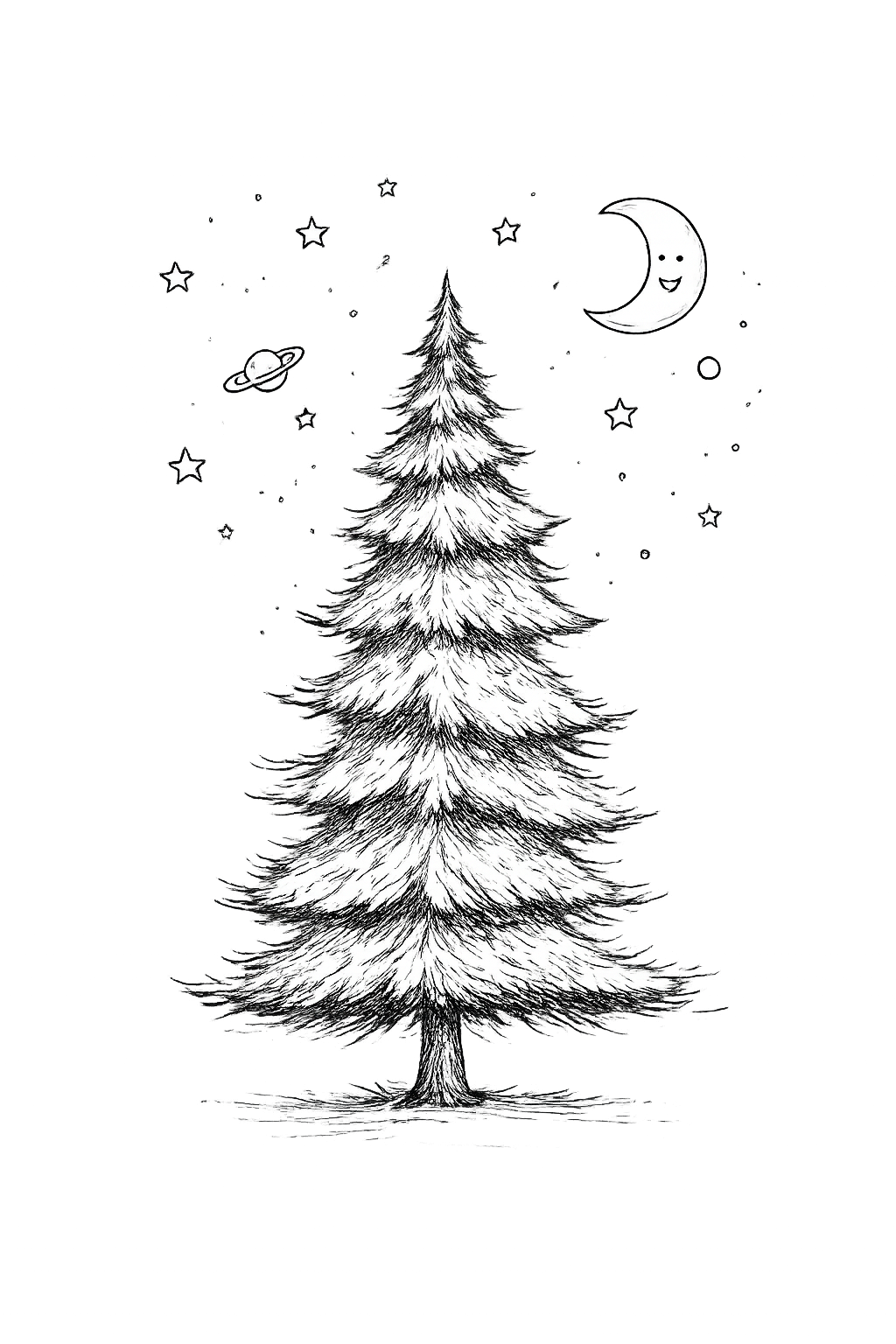
There's a pine tree outside my bedroom window—taller than it used to be, or maybe I just notice it differently now. It doesn't measure time the way I do. It holds it internally—rings stacked on top of each other, good years and difficult years compressed into the same structure. You wouldn't know the difference unless you cut into it, and even then, you'd only see the pattern, not the experience.
The moon still passes over the house the same way it always did—predictable, cyclical, indifferent. It measures time externally, in phases you can watch, count, rely on. The tree and the moon don't negotiate with each other. They don't adjust to make the relationship easier. They coexist—aligned without dependency, interacting without control.
What this feels like now is not reconciliation—it's something cleaner than that. Coexistence perhaps. The past doesn't change. I don't need it to. I don't need the house to become something it wasn't in order to stay here.
Some of the most interesting people lead meaningful lives that looked more like annotated drafts—cross-outs, marginalia, brilliant sentences next to absolute chaos. And honestly, the people who seem "put together" are usually just better at curating what they show. The house doesn't ask me who I am anymore. It never really did.
|
Copyright © 1998-2026 Emily Pratt Slatin. All Rights Reserved. About | Archives | Biography | EMD Codes | Notebook | Press Kit | Pronouns.page | RSS Feed | Sitemap | YouTube Made with grit in Middletown Springs, Vermont. |